> [!meta]- Document Info
> **Author**: [[Kyle Poyar]]
> **Full Title**: From Selling Access to Selling Work
> **Category**: #articles
>
> **Summary**: The software industry is shifting from selling access to charging for the work delivered by AI, moving away from traditional annual recurring revenue (ARR) models. Companies like Intercom and Zendesk are leading this change with pricing based on successful AI resolutions rather than seat licenses. This new approach offers potential cost savings for customers and more revenue opportunities for vendors, but it also brings challenges in revenue forecasting and customer management.
>
> **Source**: [Original URL](https://www.growthunhinged.com/p/from-selling-access-to-selling-work)
## 📄 Full Document
→ [[From Selling Access to Selling Work]]
## 🔦 Highlights & Commentary
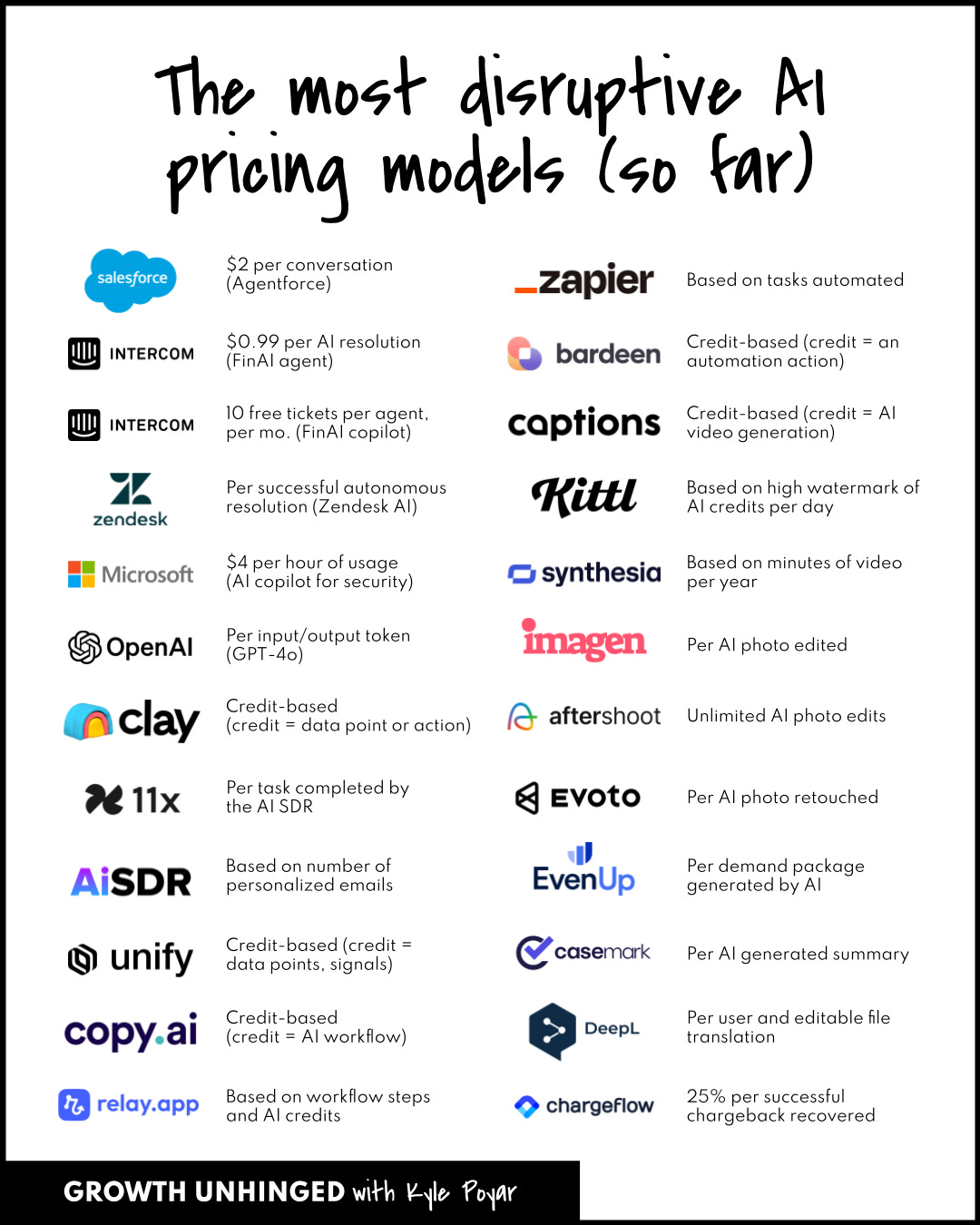
- We're moving away from charging for **access to software** and toward a model of charging for the **work delivered** by a combination of software and AI agents. ([View Highlight](https://read.readwise.io/read/01jbw0tpbwtbwtzp2a308k0c95))
- Note: Thesis of a big shift here
- Technology companies are realizing they can't solely rely on seat-based subscriptions in an age of AI, automation and APIs where value is disconnected with how many people are logging in. ([View Highlight](https://read.readwise.io/read/01jbw0w0c6szc795hwbzgkqx83))
- Note: If Software + Agents is meant to "raise the ceiling & lower the floor" for FTEs, the frame shifts to "what you do for me" not "what your software enables me to do." Changes the base of the value roadmap pyramid substantially.
- Folks are increasingly selling **units of work completed** rather than selling access to the software (seat licenses) or consumption of the software (usage). ([View Highlight](https://read.readwise.io/read/01jbw11x5n5zakvgpnknrap06z))
- In my experience, subscription SaaS products capture about 10-15% of the estimated economic value they claim to deliver to their customers. Those with success-based billing can capture closer to 20-30% because there’s a more direct correlation between the product and the result. Output-based pricing, where customers pay for units of work delivered, falls somewhere in between. ([View Highlight](https://read.readwise.io/read/01jbw14c8gq3dfx636rkqj0hth))
- Note: Phase 1: Buy the thing
Phase 2: Rent the thing
Phase 3: Pay for the unit of work
Phase 4: Pay for successful units of work
- You want the customer to get a fantastic outcome — and you want them to recognize that your product powered that outcome. As soon as you start charging for success, the customer begins to rethink the results. Did your product really drive the outcome? Or did *they* drive the outcome with a small assist from the product? ([View Highlight](https://read.readwise.io/read/01jbw165tj5sa0qsgfqv7tmnrt))
- Note: Attribution moving from inside-baseball to primary value perception methods.
- These new AI pricing models might mean greater volatility in both usage and spend. Variable margin profiles across products and customers. Seasonal revenue fluctuations. The potential for project-based, non-recurring use cases. ([View Highlight](https://read.readwise.io/read/01jbw185pr2pby1a8qymwkkefa))
- Note: Second and third order effects on how investors evaluate -> how businesses report -> how teams organize and operate
- We’ll pay closer attention to **revenue concentration** as I suspect there will be a far wider variance between the smallest and largest accounts. ([View Highlight](https://read.readwise.io/read/01jbw1a9hnxfwzxxxtsnkmfraq))
- Every day is now a potential revenue event, or a churn event. There's zero room for shelfware or 60% of licenses never logging in. ([View Highlight](https://read.readwise.io/read/01jbw1cf2tar0m7hmt41k95tb7))
- Note: Potential for traditional lifecycle handoffs become impediments to growth. More fodder for "Integrated GTM"