---
type: book
subType:
title: The Art of Running
year: "2022"
pages: 220
author:
- Andrea Marcolongo
banner: "https://www.europaeditions.com/spool/cover_9798889660330__id2334_w240_t1703067952__1x.jpg"
onlineRating: 3.4
isbn:
isbn13:
released: true
read: true
lastRead: 2025-02-24
currentPage: 220
recommender:
personalRating: 3.75
url:
id:
status: read
created: 2024-06-24-Monday
series:
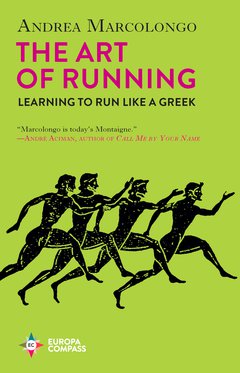
description: "Join Andrea Marcolongo, renowned classicist and one of today's most original thinkers on antiquity, for an inspiring journey as she learns to run--and to live--like a Greek.\r\rWhy do we run? To what end, all the effort and pain? Wherefore this love of muscle, speed, and sweat? The Greeks were the first to ask these questions, the first to suspend war, work, politics, to enjoy public celebrations of athletic prowess. They invented sport and they were also the first to understand how physical activity connected to our mental well-being.\r\rAfter a lifetime spent with her head and heart in the books trying to think like a Greek, at a professional and personal crossroads, Andrea Marcolongo set out to learn how to run like a Greek. In doing so, she deepened her understanding of the ancient civilization she has spent decades studying and discovered more about herself than she could ever have dreamed.\r\rIn this spirited, generous, and engaging book, Marcolongo shares her erudition and her own journey to understanding that a healthy body is, in more ways than one might guess, a healthy mind."
review: There are a lot of unfair reviews for Marcolongo's work in The Art of Running. It's all about intent. If you came here for another book on the mechanics of running, you're looking for the wrong thing. Much more in the vein of Murakami's What I think About When I Think About Running, The Art of Running is a treatise on how running changes our relationship with ourselves and the world around us. It's a slow start, but really shines in the middle (Chapters 4-8) where Marcolongo reflects on our relationship with time, our physical selves, our rich inner landscapes, nature, and the collective of humanity.
tags:
- "#mediaDB/book"
storygraph: https://app.thestorygraph.com/reviews/29569dd0-7166-4538-8bdc-115266919f2f
---
# The Art of Running (2022)
>[!info]+ metadata
>*`= this.tags`*
>- Online Rating - `=this.onlineRating` | My Rating- `=this.personalRating`
>- Status - `=this.status`
>- Progress - `=this.currentPage` of `=this.pages`
>- `=this.storygraph`
## Summary
`=this.description`
## My Thoughts
>[!quote]+ My Review
>`= this.review`
### Highlights
#### Chapter 4, Taming Time: Kairos, Flow, and the Present Moment
There is some interesting commentary in this chapter about being totally present in time. I really love thinking about a flow state as a "circle that expands on every point of the line that we decide to put to good use." It suggests to us that our experience of time doesn't need to be as linear as a "timeline," and indeed we can, in the right circumstances, expand outward. Visually/philosophically it's an appealing concept. Maybe it's speaking to me in the moment because I'm very aware of time passing, and that I'm getting older. But I appreciate the idea that time exists both objectively and subjectively. There is the time that passes, but there is what we do with the time as it passes. I've certainly experienced that running is one way to tap into this state.
- ["] This arises from the nature of things, from their transience and the urge to respond to that transience. If time is a straight line, with a beginning and an end, kairos is a circle that expands on every point of the line that we decide to put to good use. - [[The Art of Running (2022)]]rt of Running (2022)]]rt of Running (2022)]], Chapter 4, Page 79
- ["] What the English have dubbed flow and the Greeks once called kairos, Eastern philosophies refer to as total consciousness or, in the current parlance, mindfulness, present-moment thinking. To be there, in the moment. To be entirely there without trying to change or control it. Indeed, to put yourself in the hands of life, to let yourself be— sim[[The Art of Running (2022)]]rt of Running (2022)]]rces/media/Books/The Art of Running (2022)]], Chapter 4, Page 82
- ["] According to cognitive scientists, the state of flow, this chance to cling so firmly to time that you penetrate it, can be experienced not only in sports but in spiritual dimen-sions, in education (does anyone else remember being so intensely absorbed by an idea or method that it felt more like being in a trance than hitting the books?) and, in cases tha[[The Art of Running (2022)]]rt of Running (2022)]]n sexuality. - [[The Art of Running (2022)]]rt of Running (2022)]], Chatper 4, Page 83
- ["] Now that I know it's my right, that time— and every time of my existence—I want it. I no longer worry about it, even if it's worse than others' times or different from the time I'm expecting. Actually, I plan to claim every last second of it, without cheating. The alternative would mean leaving no trace or living ou[[The Art of Running (2022)]]rt of Running (2022)]]being disqual-ified, like a thief. - [[The Art of Running (2022)]]rt of Running (2022)]], Chapter 4, Page 87
#### Chapter 5, Running *(N., Fem.)*
A humbling chapter reading Andrea's experience as a woman, and as a runner. There are a lot of things I take for granted in my experience as a runner. I've maybe known this academically, but this chapter pulled it forward into a spotlight that I hadn't spent much time examining. Also, what a turn of phrase: "feeling broadly moved by the triumphs of a handful of men and women may be the toxin that keeps the rest of us from being actively committed."
- ["] There's no account of the fortunes of Atalanta after the two we[[The Art of Running (2022)]]rt of Running (2022)]]ple no longer spoke of this first mythic runner's races. - [[The Art of Running (2022)]]rt of Running (2022)]], Chapter 5, Page 97
- ["] Before I took up running, Katherine Switzer's heroic acts hadn't inspired me much. Moved me, yes, but feeling broadly moved by the trium[[The Art of Running (2022)]]rt of Running (2022)]]omen may be the toxin that keeps the rest of us from being actively committed. - [[The Art of Running (2022)]]rt of Running (2022)]], Chapter 5, Page 102
- ["] Yet what I didn't know before feeling literally indecent while running was the same thing Plato noticed when he beheld the spectacle of half-naked women athletes: that our bodies are often sexualized a priori, without our even realizing it. We look sexy n[[The Art of Running (2022)]]rt of Running (2022)]]one has made the decision for us, and this is so ingrained in us that we struggle to be aware of it. - [[The Art of Running (2022)]]rt of Running (2022)]], Chapter 5, Page 104
- ["] He can imagine them, sure. He can summon all the empathy in the world. But he can't physcally feel them with his five senses. Indee[[The Art of Running (2022)]]rt of Running (2022)]] he can run a marathon a week. Nothing that he decides to do to his body, good or bad, influences the health of this baby. - [[The Art of Running (2022)]]rt of Running (2022)]], Chapter 5, Page 108
#### Chapter 6, Born to Run
A resonating chapter for me, that explores the complicated relationship between self and running. Why do we do it? Where do our motivations come from? There is obvious external pressure to be healthy or pretty or fit or whatever flavor of ideal you value most. But there is internal pressure to know oneself, physically, and have that become the lens through which you experience yourself. Running as a mechanism that allows one to feel themselves for the first time, and forever more the barometer for feeling. From this angle the external desire to "perform" melts away and instead we find a need to know ourselves better, and better make sense of our relationship with everything outside our rich internal landscapes.
- ["] More than once on my route I have wondered whether we ought to consider running a need of the body or an imposition, however pleasant, of the mind; whether our legs naturally desire to run to overcome the unnatural sede[[The Art of Running (2022)]]rt of Running (2022)]] forced to spend a large part of our days, or whether our brain is urging our feet to continue to make an effort that goes against their nature. - [[The Art of Running (2022)]]rt of Running (2022)]], Chapter 6, Page 116
- ["] On a broader political and sociological level, I'm interested to know whether our current way of looking at running is really a reflection of its being the most democratic of sports, as runners, chuffed after a few laps around the neighborhood and thinking they're the Che Guevaras of the increasingly sophisticated and expensive sports world, insist it is, or whether it[[The Art of Running (2022)]]rt of Running (2022)]]ology that demands women and men be better looking, younger, healthier, and thinner for longer, which in actuality makes us slaves to the sport, rather than pioneers. - [[The Art of Running (2022)]]rt of Running (2022)]], Chapter 6, Page 115
- ["] I often feel that for many people, including my-self, sports has become not a door flung open but a cage we willingly enter. Maybe it's the slightly downhearted words and fatalist tones that runners preparing for a race use to talk about their training, like "I've got a long session today" or "tomorrow I have to do intervals," where what is audible isn't enthusiasm but the kind of sigh of defeat you expect to hear at the back of the line at the post office. Maybe it's the relentless-to-the-point-of-stalking appeals that institutions and the media make, urging us [[The Art of Running (2022)]]rt of Running (2022)]]healthy. Or maybe it's just because running means suffering, often a lot, whereas satisfying other natural needs, like eating, sleeping, and having sex, gives us satisfaction and pleasure. - [[The Art of Running (2022)]]rt of Running (2022)]], Chapter 6, Page 1[[The Art of Running (2022)]]rt of Running (2022)]]volutionary leap, that spurt of freedom and progress, in the last thirty or forty years our sports madness hasn't liberated Western society (from what exactly?) but rather, it seems, suppressed and enslaved it. - [[The Art of Running (2022)]]rt of Running (2022)]], Chapter 6, Page 117
- ["] For the first time my body made itself felt and had the floor; I could hear its voice. Always caught up in my thoughts, I was now being forced to ask what, besides four friendly neurons, I really was. It was as if someone was happily[[The Art of Running (2022)]]rt of Running (2022)]]hich I was accustomed to looking at the world and which had long been trained on the outside world for me to catalog, understand, and de-construct. When I ran, the focus abruptly shifted to my inner being, to the matter I'm made of. - [[The Art of Running (2022)]]rt of Running (2022)]], Chapter 6, Page119
- ["] There com[[The Art of Running (2022)]]rt of Running (2022)]]er talent you've been given is no longer enough and the hope that you can continue to profit from a handful of such gifts without working at them turns out to be ridiculous. If, that is, you were lucky enough to discover what they are in the first place. - [[re[[The Art of Running (2022)]]rt of Running (2022)]]f Running (2022)]], Chapter 6, Page 120
- ["] When we run for pleasure and not to compete with others of come out victorious, we're not playing sports, we're playing like rascals, like Carlo Collodi's wooden boy Pinocchio who gets into all sorts of trouble as he [[The Art of Running (2022)]]rt of Running (2022)]]edia/Books/The Art of Running (2022)]], Chapter 6, Page 125
- ["] When rules, time limits, codes of conduct and objectives are applied to taking a kick, or thwacking a ball with a racquet, or simply running, the game stops bein[[The Art of Running (2022)]]rt of Running (2022)]]freedom and turns into an organized sport. - [[The Art of Running (2022)]]rt of Running (2022)]], Chapter 6, Page 125
- ["] It is thanks to this apparently limitless freedom of play that runners never tire of running, unlike children who, after a few minutes of fid[[The Art of Running (2022)]]rt of Running (2022)]] bored and demand another. - [[The Art of Running (2022)]]rt of Running (2022)]], Chapter 6, Page 127
- ["] What left me feeling not hurt but tamed, re-signed, like a conquered population, was the absolute certainty that, even if I had started running when I was still in my diapers and never quit, I still would never have become a champion. - [[resources/media/Bo[[The Art of Running (2022)]]rt of Running (2022)]]]], Chapter 6, Page 130
- ["] This obvious and unresolvable disparity between those who possess talent and those who will never possess it may be the most anti-modern side of running and of sports in general, because it strikes at the root of the contemporary idea that, with hard work and dedication, one can arrive wherever one wants and be whomever one [[The Art of Running (2022)]]rt of Running (2022)]]Books/The Art of Running (2022)]], Chapter 6, Page 130
- ["] After being raised to believe that studying was the one way to reverse disadvantageous social or political conditions and with the almost Calvinist conviction that all my hard work would sooner or later pay off, as a runner I realized how unequally talent is distributed among human beings and how impossible it is to remedy. - [[The Art of Running (2022)]]rt of Running (2022)]], Chapter 6, Page 131
- ["] Sadly, the rift between those who ar[[The Art of Running (2022)]]rt of Running (2022)]]re born to walk cannot be bridged. Given or denied, talent accepts no substitutes. Yet this injustice doesn't take away from the dignity of people courageous enough to want to improve upon what they've been conceded, be it a little or a lot. That's what's most democratic about running: no matter how ph[[The Art of Running (2022)]]rt of Running (2022)]]cannot get around having to train regularly-and keep the faith occasionally. - [[The Art of Running (2022)]]rt of Running (2022)]], Chapter 6, Page 133
#### Chapter 7, *In Corpore Sano*
- ["] If we follow this line of thinking, running entails a healthy dose of exhibitionism. Which is why some people, even people in excellent physical shape, detest running and would willingly be crucified before running a yard in plain sight. - [[The Art of Running (2022)]]rt of Running (2022)]], Chapter 7, P[[The Art of Running (2022)]]rt of Running (2022)]]me most aren't my supportive fellow runners but all those who have chosen not to run. Because they remind me so much of what I was like before I chose to run, and I don't like that image of myself. The prospect of going back to being the lazy—morally lazy, e[[The Art of Running (2022)]]rt of Running (2022)]] and abandoning the good habits that the more honest part of me recognizes are still tenuous and new so disturbs me that I'm driven to run even farther, even faster. - [[The Art of Running (2022)]]rt of Running (2022)]], Chapter 7, Page 14[[The Art of Running (2022)]]rt of Running (2022)]] Not much anyway. Since I started to run my perception of my body's basic needs-what my body tells me to do so that I can go running again the next day—is so refined that I often w[[The Art of Running (2022)]]rt of Running (2022)]][[The Art of Running (2022)]]rt of Running (2022)]], Chapter 7, Page 142
- ["] No one, or at least no one who takes their health to heart, is interested in eating better tasting food. We all want to eat healthier food, and when it comes to our wellbeing we're willing to sacrifice taste. - [[re[[The Art of Running (2022)]]rt of Running (2022)]]f Running (2022)]], Chapter 7, Page 147
- ["] If biology is the study of life, how have we come to consider, in the span of a few years, what is simply "naturally alive" to be commercially good"? - [[The Art of Running (2022)]]rt of Running (2022)]], Chapter 7, Page 148
- ["] The crazy thing [[The Art of Running (2022)]]rt of Running (2022)]]lieved that the way the fields, seas, mountains, and rivers naturally yielded us their bounty could be circumvented, modified, perfected (as if it [[The Art of Running (2022)]]rt of Running (2022)]] technology and a great deal of arrogance. - [[The Art of Running (2022)]]rt of Running (2022)]], Chapter 7, Page 148
- ["] We want an organic apple to be like an[[The Art of Running (2022)]]rt of Running (2022)]]rally have produced rather than a ball of pesticides, yet none of us can recall what it was like before, when nothing was [[The Art of Running (2022)]]rt of Running (2022)]]s a fact of life, not a supermarket sticker. - [[The Art of Running (2022)]]rt of Running (2022)]], Chapter 7, Page 149
- ["] It seems that, at least when it comes food, health[[The Art of Running (2022)]]rt of Running (2022)]]re because we no longer accept death. - [[The Art of Running (2022)]]rt of Running (2022)]], Chapter 7, Page 150
- ["] But when we get so worked up about not getting sick, that voice murmuring in our ear that death is inevitable starts to get louder. - [[resources/media/Books/The[[The Art of Running (2022)]]rt of Running (2022)]]pter 7, Page 150
- ["] We've gone from ridding death of its tragic sense to being generally afraid of getting old. - [[The Art of Running (2022)]]rt of Running (2022)]], Chapter 7, Page 150
- ["] More than anything running has taught me that nature exists—I mean concretely, not as some abstract idea divided into even more abstract seasons. - [[The Art of Running (2022)]]rt of Running (2022)]], Chapter 7, Page 154
- ["] Indeed running is one of the few activities that restores human beings to their rightful place, getting them off the couch or out from behind a desk and p[[The Art of Running (2022)]]rt of Running (2022)]]onment where they came into this world many millennia ago: nature. - [[The Art of Running (2022)]]rt of Running (2022)]], Chapter 7, Page 154
- ["] Forcing me to concentrate on what's going on around me, not just inside me, running has given me the rare gift of feeling like a part of nature rather than someone admiring the view high up on a balcony. And mayb[[The Art of Running (2022)]]rt of Running (2022)]] has gone back to doing what it was programmed to do from the age of the first homo sapiens: cataloging the outside world-nature-and keeping an eye out for threats and prey instead of wearily scanning the endless fields of its own thoughts, where t[[The Art of Running (2022)]]rt of Running (2022)]] palpable is our own stress. - [[The Art of Running (2022)]]rt of Running (2022)]], Chapter 7, Page 155
#### Chapter 8, Kalos Kagathos: Aesthetics and Running
- ["] Maybe my muscles haven't changed much since my lounging around da[[The Art of Running (2022)]]rt of Running (2022)]]t. My mind is tbe part of my body that running has most boned, not my legs so much so that I wonder why on earth I never ran before and, more importantly, why doesn't everyone run. - [[resources/media/Books[[The Art of Running (2022)]]rt of Running (2022)]] Chapter 8, Page 165
- ["] Now I see clearly what this mysterious thing called mental health is made of, that which all runners, first to last, regard as the holy grail of footracing. It's relief from the mind's relentless, aggravating chatter. - [[The Art of Running (2022)]]rt of Running (2022)]], Chapter 8, Page 175
- ["] You suffer when you run because your body would [[The Art of Running (2022)]]rt of Running (2022)]], as a counter measure, your mind takes pleasure in it. Your legs move and your thoughts stop racing, as if under a spell. - [[The Art of Running (2022)]]rt of Running (2022)]], Chapter 8, Page 176
- ["] Running is hard, sometimes very hard, but the peace of mind it affords is unequalled. The price of that peace depends on how willing we are to stretch our bodies to obtain it. - [[The Art of Running (2022)]]rt of Running (2022)]], C[[The Art of Running (2022)]]rt of Running (2022)]]ed to believe that the thousands of us who storm the streets of our cities every day form a kind of large tribe, bound by a set of unwritten rules and united in our suffering. But I was dead wrong. We're hermits. In non-professional running everything is relative to oneself. There is no more solitary and self-involved sport in the world. - [[The Art of Running (2022)]]rt of Running (2022)]], Chapter 8, Page 185
- ["] If achieving a common, objective, selfless goal is considered too onerous after the major movements of the 1960s and '70s, or the shiny patina of w[[The Art of Running (2022)]]rt of Running (2022)]]em vain, then human beings, who by their nature must yearn for something if they mean to survive, have moved the goalposts. What they deem worthy of their efforts has gone from external to internal, from collective to individual. - [[The Art of Running (2022)]]rt of Running (2022)]], Chapter 8, Page 185
- ["] Since our[[The Art of Running (2022)]]rt of Running (2022)]] come crashing down, from government to religion and all the structures of civic engagement in between, happiness has now become so private—and sold pre-privatized at a dear price—we may as well try to manufacture it ourselves and be our o[[The Art of Running (2022)]]rt of Running (2022)]]the obligation to be permanently performing, to compete every damn morning, so that in the evening we can say we've won (whether we've bested ourselves, our schedules, the gaze of others, or the watch on our wrists doesn't matter). - [[resources/[[The Art of Running (2022)]]rt of Running (2022)]]g (2022)]], Chapter 8, Page 185
- ["] Up until thirty years ago we took to the streets to stand up for our ideals and demand a more dignified future. Today, we take to the same streets to run alone and in silence, hoping that our individual liberties are earned with six-packs, calves of steel, and a forgettable personal best. - [[The Art of Running (2022)]]rt of Running (2022)]], Chapter 8, Page 186
- ["] This is how jogging, an activity whose only point is to stretch [[The Art of Running (2022)]]rt of Running (2022)]]as recently developed into running, i.e., an activity with goals, workout routines, recorded times, and iron wills. - [[The Art of Running (2022)]]rt of Running (2022)]], Chapter 8, Page 186
#### Chapter 9, Marathon-Athens
- ["] But what I most hope to prove by this pathetic effort is that I still have time, that adulthood (read: old age) is rela-tive, as obscenely terrified people such as myself like to[[The Art of Running (2022)]]rt of Running (2022)]]ks/The Art of Running (2022)]], Chapter 9, Page 199
#### Chapter 10, Recovering
- ["] Whereas my delight at having completed the first marathon in my life seemed to last little more than five minutes. It didn't even possess the intensity to morph into happi-ness, that form of beatitude that floods and supports every other aspect of existence, multiplying ideas and energies. Instead it remained a wispy trace of joy, which gave way to an average good [[The Art of Running (2022)]]rt of Running (2022)]]ppeared in a jiff. - [[The Art of Running (2022)]]rt of Running (2022)]], Chapter 10, Page 214
- ["] And after a good hour under scalding hot water, I noticed that my sense of satisfaction was waning, tha[[The Art of Running (2022)]]rt of Running (2022)]]rgency had rushed in to take up space in my head, that I was already worrying about other things, that I didn't have some great epiphany after running twenty-five miles, and in fact I wanted to move on to the next thing as quickly as possible. - [[The Art of Running (2022)]]rt of Running (2022)]], Chapter 10, Page 215
- ["] Despite my modest performance, even I felt reluctant about immediately "leaving" the protected, intimate space of my run. I know I appeared brusque and unheroic, but I was bothered, almost irked by people who wanted to talk and celebrate my race the second I'd stopped running. What do these people want, I wondered. Why are they forcing me to smile? Why do I have to pretend to be happy just to avoid disappointing them? - [[The Art of Running (2022)]]rt of Running (2022)]], Chapter 10, Page 217
- ["] For the past few days I'd observed that my "resting state" wasn't all that restful. I felt irritable, antsy about being so physically immobile and psychologically restless. - [[The Art of Running (2022)]]rt of Running (2022)]], Chapter 10, Page 219